Foundation Piers and Pilings in Tyler, TX

Most foundation repair quotes in East Texas come down to a pier type and a pier count. Pressed concrete piles, steel push piers, helical piers and drilled piers all lift and support a foundation, but they work differently. Describe your house once, and independent foundation repair companies serving Tyler and nearby towns can reply with free quotes you can compare. Tyler TX Foundation Experts is a quote service, not a contractor.

Get a Free Quote Call (323) 880-1300
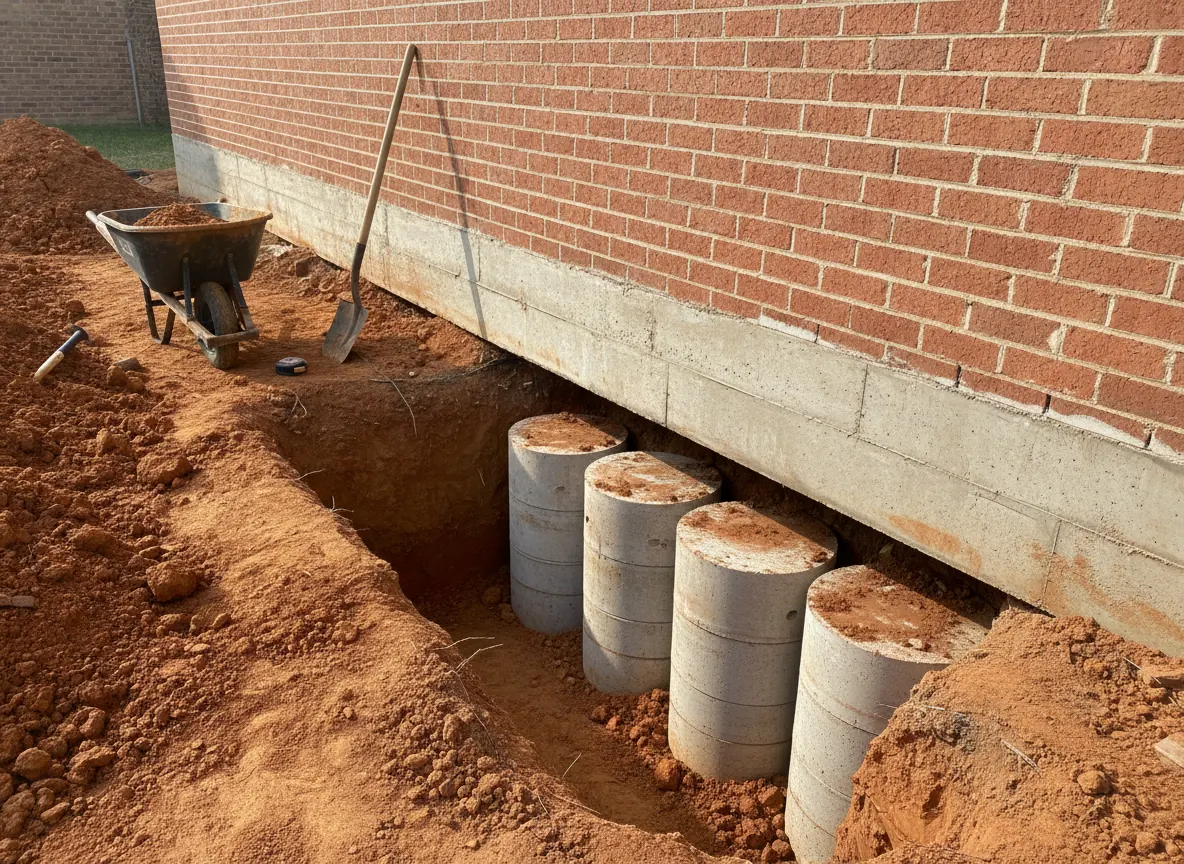
Pressed concrete piles under a slab grade beam
Warning signs

Signs a foundation may need piers

  • One corner or side of the house sits lower, confirmed by floor readings
  • Stair-step cracks in brick that keep widening
  • Doors and windows that stick on one side of the house
  • A gap between the brick and a window or door frame
  • A slab crack where one side sits higher than the other
  • A perimeter beam that has visibly dropped at a pier-and-beam house

Piers fix settlement. They do not fix a drainage problem, and a house that moved because of a plumbing leak or a missing downspout may need those fixed too. See drainage and grading.

Pier types

Pressed pilings vs. steel piers vs. helical vs. drilled piers

Pressed concrete piles

Short precast concrete cylinders are pressed into the ground one on top of another, using the weight of the house as resistance, until they stop. The beam is then lifted and set on top with a cap and shims. Common on Texas slab repairs. Ask how many cylinders each pile took and whether a cable or rod ties them together.

Steel push piers

Steel pipe sections are pushed down beside or under the beam with a hydraulic ram, usually attached with a bracket, until they reach firm soil or refusal. They can go deeper than pressed piles. Ask for the depth of each pier and the pressure recorded.

Helical piers

Steel shafts with screw-like plates are turned into the ground until they reach a target torque, which relates to load capacity. Ask for the torque log.

Drilled piers

Holes are drilled and filled with reinforced concrete, sometimes with a belled bottom. They take longer to install and cure, and the depth is set by design. Ask whether an engineer specified the depth and steel.

Quotes from two companies with different methods show the trade-offs. More in pressed pilings vs. steel piers vs. helical piers.

How it works

How a pier job usually runs

  1. Floor survey

    Elevation readings show where the house is low and by how much.

  2. Pier plan

    Each pier is marked on a drawing with type, count and spacing.

  3. Install piers

    Piers are pressed, pushed, turned or drilled, and depth, pressure or torque is recorded.

  4. Lift and set

    The beam is raised slowly to target readings and set on caps and shims.

  5. Backfill and records

    Final readings, the pier log and warranty terms in writing.

Reading a quote

What a quote's pier count and spacing mean

Pier count is usually the biggest line on a foundation quote. A few things to check when two quotes look different:

  • Where the piers go. Some plans support only the low corner; others run along a whole side. A drawing makes this clear.
  • Spacing. Ask for the distance between piers in feet and why the company chose it for your beam and soil.
  • Interior piers. These cost more because of floor demolition and repair. Ask who restores the flooring and whether that is in the price.
  • Price per pier. For pressed concrete piles, no authoritative per-pier price is published and quotes vary, so ask for the price per pier in writing.

Much of Tyler and Smith County is mapped in sandy and loamy soils, many over red clay subsoils with moderate shrink-swell potential (USDA NRCS). That mix means poor drainage, erosion and long dry spells can all move a foundation. On deep sandy lots, piers may need to travel farther to reach firm soil; on lots with red clay subsoil, the clay layer can shrink and swell with the seasons. In 2011, all of Smith County was in exceptional drought for 21 weeks (U.S. Drought Monitor), and Tyler had 46 straight days of 100°F-plus heat that summer (NOAA). Soils vary block by block, so the companies' own readings and records matter more than any map.

Typical cost

What foundation piers cost

ItemTypical rangeSource
Piers (underpinning), per pier$1,000–$3,000 eachFixr, Jan 2026
Slab foundation repair$1,000–$10,000Fixr, Jan 2026
Pier-and-beam repair$2,000–$15,000Fixr, Jan 2026
Structural engineer report$300–$2,000Fixr, Jan 2026

Typical national ranges from published 2026 cost guides (Fixr, Jan 2026; This Old House, Oct 2026). Your price depends on an on-site evaluation.

The per-pier range above is a national figure for underpinning piers in general, not for pressed concrete piles. No authoritative per-pier price for pressed concrete piles exists, so quotes vary and you should ask for the price per pier in writing. The cost guide has a calculator that multiplies the general per-pier range by your pier count.

Is it urgent?

When settlement needs a quick look

Ask for an evaluation soon if

  • A crack has widened noticeably in weeks, not months
  • Brick is bulging or pulling away from the frame
  • Exterior doors will not close or lock
  • Water is coming up through a floor crack

Most settlement is slow enough to compare written quotes. See foundation inspections and slab foundation repair.

Before you sign

Questions to ask before you sign

  • Who designs the repair, and does a PE review or sign off on it?
  • Which pier or support type, how many, and at what spacing, marked on a drawing?
  • Is the written estimate itemized, including interior work, drainage, permit and cleanup?
  • Ask whether the warranty is transferable if you sell the home, whether there's a transfer fee, and what it covers.
  • Can you show proof of liability insurance?
  • Who checks whether a permit is needed?
  • Which pier type will you use, and what is the price per pier in writing?
  • How is each pier's depth, pressure or torque recorded, and will I get the log?

Texas rules worth knowing

Texas does not issue a state license for foundation repair companies, so check experience, insurance, written warranties and reviews yourself, and ask whether a licensed professional engineer (PE) designs or signs off on the repair.

An independent Texas-licensed professional engineer works for you, not the repair company. You can look up a PE's license with the Texas Board of Professional Engineers and Land Surveyors (pels.texas.gov).

Whether your repair needs a City of Tyler building permit or an engineer's plan depends on the work. Your contractor should check with Tyler Building Services (423 W. Ferguson St., 903-531-1151). In other towns, check with the city's building department. Outside city limits, Texas counties generally don't issue building permits for home repairs.

Texas law gives you until midnight of the third business day to cancel many contracts signed at your home after a sales visit (Tex. Bus. & Com. Code §601.051). Ask whether it applies to your contract and look for the cancellation form.

Questions

Foundation piers and pilings FAQs

How much do pressed concrete piles cost per pier?

No authoritative published guide gives a per-pier price for pressed concrete piles, and quotes vary by company. Ask each company for the price per pier in writing, along with the pier count, so you can compare. National guides put underpinning piers in general at about $1,000 to $3,000 each (Fixr, Jan 2026), but that is not a pressed-pile figure.

Pressed pilings or steel piers: which is better?

Neither is right for every house. Pressed concrete piles are common on Texas slab repairs; steel push piers and helical piers can reach deeper. The best choice depends on the soil, the house load and how far down firm bearing is. When two companies propose different systems, an independent engineer's evaluation helps you compare.

What does pier spacing on a quote mean?

Spacing is the distance between piers along the beam. Closer spacing means more piers and more support; wider spacing means fewer piers and a lower price. Ask each company to show piers on a drawing with spacing in feet, and ask why it chose that spacing for your house.

How deep do foundation piers go?

It depends on the system and the soil. Pressed piles and push piers go until they meet resistance, so depth is recorded during the job. Helical piers are turned in until they reach a target torque. Drilled piers are dug to a designed depth. Ask how depth is recorded and whether you get the log.

Get free foundation pier quotes

Tell us whether the house is slab or pier and beam, where it seems low, roughly how old it is and whether you already have a quote or an engineer's report. Tyler TX Foundation Experts passes your request to independent foundation repair companies serving Tyler and East Texas, and they reply to you directly. Companies may pay to receive requests. There is no cost to you and no obligation.

Get free quotes

Independent East Texas foundation companies reply to you directly.

No obligation. Independent local companies reply to you directly.

Cracks, sticking doors or a sloping floor? Get free foundation quotes.

Describe it once and independent foundation companies serving Tyler, Smith County and East Texas can reply with no-obligation quotes.

Call NowFree Quote