
Pier and Beam House Leveling in East Texas
If the floor in one room dips, a marble rolls toward the hallway, or interior doors swing open on their own, a pier and beam house may need leveling. Leveling is not one job. It can mean a few shims, new piers, replaced sills and joists, or all of these. Here is what each part involves in East Texas, what published guides say it costs, and how to compare quotes.
Tyler TX Foundation Experts is a free quote service, not a foundation company. Independent local foundation repair companies, which may pay to receive requests, reply to homeowners with quotes, and the company you choose does the work. This article is general information, not an engineering opinion about your house.
What pier and beam leveling means
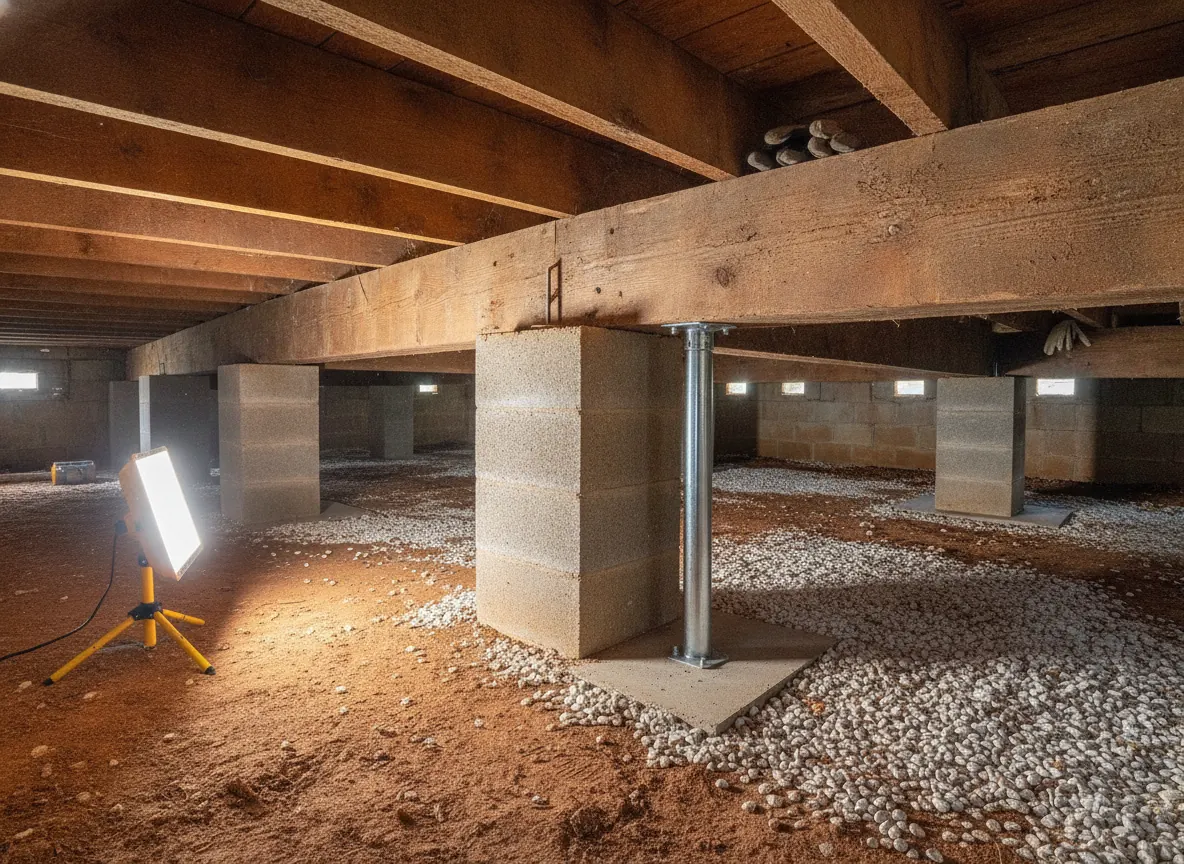
A pier and beam house sits on a grid of piers that hold up wood beams, with floor joists and a subfloor on top and a crawl space underneath. When one pier settles, heaves or rots, the beam above it sags and that part of the floor drops. Leveling is the process of bringing the floor framing back to a more even plane by adjusting, adding or rebuilding the supports, then repairing any wood that has failed.
The upside of pier and beam is access. A crew can usually crawl under the house, measure, and work on the problem directly without breaking concrete. The downside is that crawl spaces hide slow problems, such as damp soil, rot and termites, until the floor starts to show them.
Where pier and beam homes show up around Tyler
About half of Tyler's homes were built before 1980 (Census ACS 2020–2024). Older neighborhoods like the Charnwood and Azalea historic districts include many early-1900s homes, some on pier-and-beam. Newer subdivisions in south Tyler and fast-growing towns like Bullard and Lindale are mostly slab homes, though there are exceptions everywhere. Longview, Kilgore and Henderson also have large shares of older homes, so pier and beam work is common across the region.
Soil plays a part. Much of Tyler and Smith County is mapped in sandy and loamy soils, many over red clay subsoils with moderate shrink-swell potential (USDA NRCS). That mix means poor drainage, erosion and long dry spells can all move a foundation. Where a clay subsoil drains slowly, a crawl space can stay damp for long stretches, which is hard on wood sills and on the soil under the pier footings.
Warning signsSigns a pier and beam house may need leveling
- Soft, bouncy or sloping floors, often worst in one room or along one wall
- Interior doors that stick, swing open or will not latch
- Gaps between baseboards and the floor, or at the tops of door frames
- Cracked drywall or plaster above doors and windows
- Damp, musty smells, standing water or rotted wood in the crawl space
- Piers that lean, have cracked, or have loose shims on top
These are the same kinds of signs Texas home inspectors are told to report, such as out-of-square doors, sloping floors and wall cracks. An inspector's report is an opinion from what is visible, though, not a measurement of how far the floor has moved.
The main leveling methods
Measure first
A floor elevation survey with a laser or water level maps the high and low spots before anyone lifts anything. Ask for a copy, then ask for the after readings too.
Shimming
Steel or hardwood shims go between a pier cap and the beam to take up a gap. Shims are quick and inexpensive but treat the symptom, so most people see them as a short-term fix if the pier below keeps moving.
Adjustable supports
Screw-jack style steel posts or adjustable pier caps let a crew fine-tune a beam later without rebuilding the pier.
Re-piering
Failed or undersized piers are replaced, or new piers are added between existing ones to shorten a sagging span. Some companies drive pressed concrete piles under the new pier points.
Sill, beam and joist repair
Rotted sills, cracked beams and sagging joists are sistered, replaced or reinforced, and termite damage is addressed before the framing goes back to level.
Leveling an old house is rarely about getting it perfectly flat. Framing that has been out of level for decades may crack plaster or bind doors if it is forced back too fast. Ask how far the company plans to lift, over how many visits, and what it expects to happen to finishes inside the house.
Fix the moisture, or the leveling may not last. If the crawl space stays wet, new piers can settle and new wood can rot again. Many leveling quotes include ventilation, a vapor barrier or drainage work for that reason. See crawl space repair and drainage and grading.
What published guides say it costs
There is no reliable Tyler-specific price for leveling, and every house is different. These are national ranges from published cost guides, which give a sense of scale before you collect quotes.
Typical national ranges from published 2026 cost guides (Fixr, Jan 2026; This Old House, Oct 2026). Your price depends on an on-site evaluation.
| Item | Typical range | Source |
|---|---|---|
| Pier-and-beam repair | $2,000–$15,000 | Fixr, Jan 2026 |
| Piers (underpinning), per pier | $1,000–$3,000 each | Fixr, Jan 2026 |
| Structural engineer report | $300–$2,000 | Fixr, Jan 2026 |
| Foundation inspection (engineer) | $300–$1,000 (avg ≈ $600) | This Old House, Oct 2026 |
Small shim-and-adjust jobs can come in under these figures, while whole-house re-piering with sill replacement can run past them. The Tyler foundation repair cost guide has the full table and a planning calculator. For a deeper look at the repair itself, see pier and beam repair.
Questions to ask before you sign
- Will a licensed professional engineer design or sign off on the plan, or is it the company's own crew lead?
- How many piers will you add, replace or shim, and where? Please mark them on a floor plan.
- What pier type and footing will you use, and how deep?
- Which sills, beams or joists will be replaced, and is that priced per foot or as a fixed amount?
- What will you do about crawl space moisture, ventilation or a vapor barrier?
- Will you provide before and after floor elevation readings?
- What does the warranty cover, does it include future re-shimming, and is it transferable if I sell?
- Who checks whether a permit is needed?
Texas does not issue a state license for foundation repair companies, so check experience, insurance, written warranties and reviews yourself, and ask whether a licensed professional engineer (PE) designs or signs off on the repair. An independent Texas-licensed professional engineer works for you, not the repair company. You can look up a PE's license with the Texas Board of Professional Engineers and Land Surveyors (pels.texas.gov). Whether your repair needs a City of Tyler building permit or an engineer's plan depends on the work. Your contractor should check with Tyler Building Services (423 W. Ferguson St., 903-531-1151).
Texas law gives you until midnight of the third business day to cancel many contracts signed at your home after a sales visit (Tex. Bus. & Com. Code §601.051). Ask whether it applies to your contract and look for the cancellation form. The Texas Deceptive Trade Practices Act protects consumers against false or misleading claims and broken warranties.
When you are ready, request free quotes from independent companies serving Tyler and East Texas, and compare them using the list above. Call (323) 880-1300 to be connected with a local foundation repair company.
Frequently asked questions
How much does it cost to level a pier and beam house?
National cost guides put pier-and-beam repair at about $2,000–$15,000 (Fixr, January 2026), with individual piers around $1,000–$3,000 each. Small shimming jobs can cost less and whole-house re-piering more. There is no reliable Tyler-specific figure, so compare written, itemized quotes.
Is shimming a permanent fix?
Usually not. Shims fill a gap between a pier and a beam, but if the pier underneath keeps settling the gap comes back. Many homeowners treat shimming as a short-term fix and ask about adjustable supports or new piers if the same spots keep dropping.
Can a house be leveled perfectly flat?
Older homes are rarely made perfectly flat. Framing that has been out of level for years can crack plaster or bind doors if lifted too far or too fast. Ask the company what level it aims for, how it will measure, and over how many visits.
Do I need an engineer for pier and beam leveling?
Texas law does not require an engineer for every repair. An independent Texas-licensed professional engineer can still be worth it on a large job, a house you are selling, or when quotes disagree. You can check a PE's license at pels.texas.gov.