
French Drains, Gutters and Grading: Fixing Foundation Drainage in Tyler
Water that collects next to a house is one of the most common reasons a foundation starts to move, and it is also one of the cheapest problems to fix. In Tyler, French drains are the most-searched foundation-related service. Here is how gutters, grading and French drains work, when each one makes sense, and what to ask before you sign a drainage quote.
Tyler TX Foundation Experts is a free quote service, not a foundation company. Independent local foundation repair companies, which may pay to receive requests, reply to homeowners with quotes, and the company you choose does the work. This article is general information, not an engineering opinion about your house.
Why drainage matters so much in Tyler
Much of Tyler and Smith County is mapped in sandy and loamy soils, many over red clay subsoils with moderate shrink-swell potential (USDA NRCS). That mix means poor drainage, erosion and long dry spells can all move a foundation.
Those two soil types fail in different ways. On the deep sands found across parts of the city, water pouring off a roof can wash soil out from under a slab edge or a pier footing. On sandy loam over red clay, the clay layer drains slowly, so water can sit against the foundation, soften the soil and then shrink back hard when summer arrives. Either way, the goal is the same: get roof and yard water away from the house and keep the soil next to the foundation at a steady moisture level.
The weather makes that harder. Tyler averages about 42 inches of rain a year, but July is the driest month (2.1 inches) and the city sees about 98 days of 90°F-plus heat (NOAA 1991–2020 normals, Tyler Pounds Regional Airport). June is the wettest month on average, so the soil can go from soaked to dry within a few weeks at the start of summer. Year to year the swing can be even bigger: Tyler got just 25 inches of rain in 2011 and more than 68 inches in 2015 (NOAA).
Drainage is also something home inspectors look at. Under the Texas inspection standards, a TREC inspector must report drainage around the foundation that is not performing, grade problems, and gutter or downspout problems (22 TAC §535.228). If you plan to sell, fixing these items early can keep them off a buyer's report.
Start hereGutters and downspouts
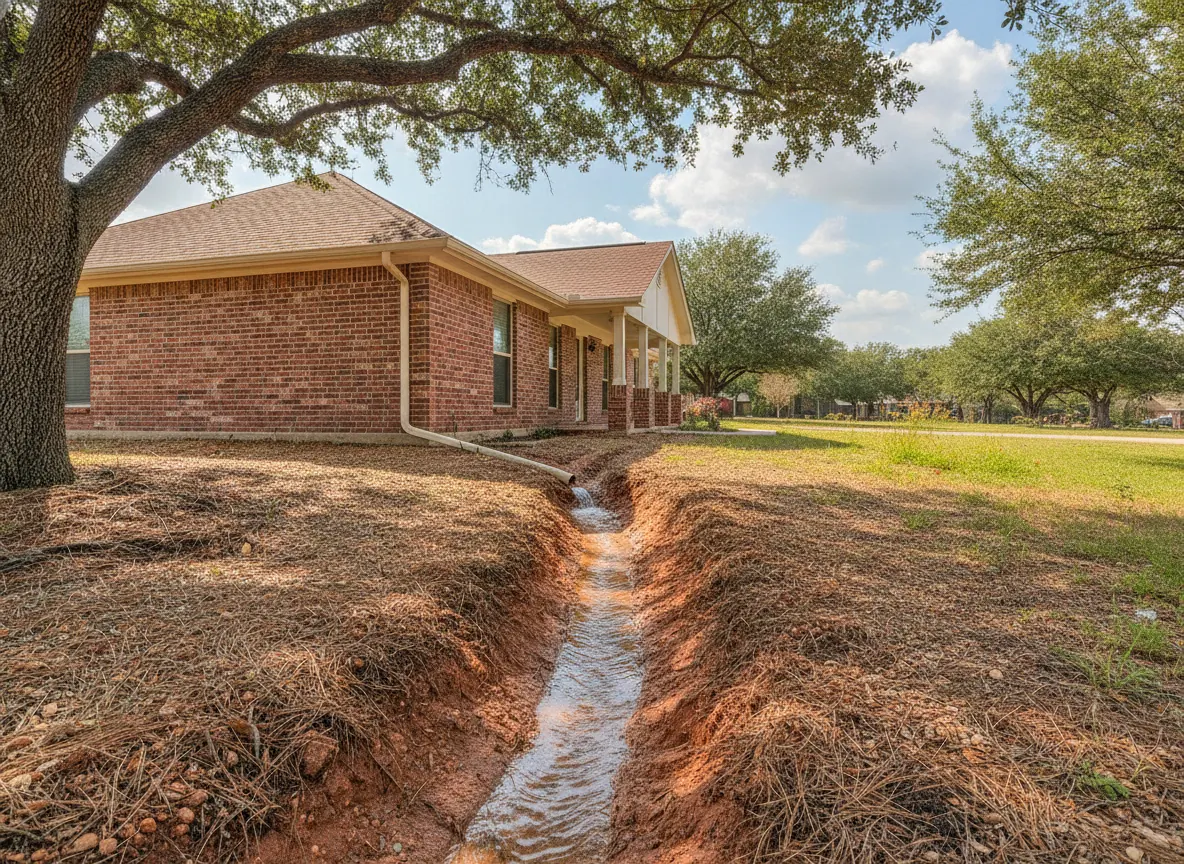
A roof sheds a surprising amount of water in a heavy storm, and without gutters most of it lands in a narrow strip right beside the foundation. Gutters collect that water. Downspouts decide where it ends up.
- Clean gutters in late fall, after pine needles and oak leaves drop, and again in spring.
- Check that each downspout carries water several feet away from the wall, onto ground that slopes away, rather than dumping it at the corner of the house.
- Look for overflow marks, stained brick or washed-out mulch under the gutter line. Those show where water is landing.
- Ask whether buried downspout lines can run to a pop-up emitter or daylight at a lower point in the yard.
- Watch the house in a hard rain once. Where water goes is easier to see than to guess.
Grading: making the ground slope away
Over the years, soil settles, mulch builds up and flower beds get edged with borders that trap water. The result is ground that slopes toward the house instead of away from it. Regrading means reshaping the soil so water runs off, usually with a gentle fall away from the wall for the first several feet. A swale, a shallow grassy channel, can then carry that water around the house to the street or a lower part of the lot.
Keep the soil and mulch line below the bottom of the siding or brick weep holes, and do not pile fill against a pier-and-beam house's skirting or crawl space vents. On hillside lots, which are common on some of Tyler's mapped soil units, grading often has to be paired with a drain because the uphill side keeps sending water toward the house.
French drains: when surface fixes are not enough
A French drain is a trench lined with fabric, filled with gravel and fitted with a perforated pipe that collects water underground and carries it to an outlet. It makes sense where water keeps arriving from somewhere you cannot regrade, such as an uphill neighbor's yard, a long driveway, or a soggy strip between houses. Some crawl spaces get an interior drain and sump for the same reason.
French drains are usually priced per linear foot, and the total depends on length, depth, how much digging is by hand, and where the outlet can go. No published guide gives a Tyler figure, so get the length, depth, pipe type and outlet location in writing on each quote and compare them line by line.
Drainage protects a foundation. It does not lift one. If a slab or pier-and-beam floor has already settled, better drainage can slow further movement but will not bring the house back to level. That takes piers, shims or other repair work. Many homeowners do drainage first, then have floor elevations checked again after a full season. See foundation drainage and grading and slab foundation repair.
Drainage and drought go together
Moving water away from the house in spring is half the job. The other half is keeping the soil from drying out and pulling away from the slab in July and August. Large pines and oaks near the house can dry out clay soil under a foundation in a drought. A drainage plan that sends every drop to the street can leave the soil under the slab edge drier in summer, so ask the company how its design works in both seasons. If you water the foundation in a dry spell, follow Tyler Water Utilities' current watering rules. The drought watering checklist covers that side.
Questions to ask before you sign a drainage quote
- Where exactly will the water go, and is the outlet on my property?
- How long and how deep is the drain, and what pipe and fabric will you use?
- Will you regrade, and how much fall will the new grade have?
- Will the work cross sprinkler lines, gas lines or tree roots, and who marks them first?
- Is the drainage work tied to a foundation repair, and is a licensed professional engineer involved in either?
- What warranty comes with the drainage work, and is it separate from any foundation warranty?
- Is this an itemized, written estimate?
Texas does not issue a state license for foundation repair companies, so check experience, insurance, written warranties and reviews yourself, and ask whether a licensed professional engineer (PE) designs or signs off on the repair. Whether your repair needs a City of Tyler building permit or an engineer's plan depends on the work. Your contractor should check with Tyler Building Services (423 W. Ferguson St., 903-531-1151). Outside city limits, Texas counties generally don't issue building permits for home repairs.
For broader repair costs, see the Tyler foundation repair cost guide. When you are ready, describe the problem once and independent East Texas companies can reply with drainage and repair quotes. Call (323) 880-1300 to be connected with a local foundation repair company.
Frequently asked questions
Can a French drain stop foundation movement?
It can help by keeping water from collecting next to the foundation, which is one common cause of movement. It cannot lift a slab or floor that has already settled, and it will not stop movement caused by plumbing leaks or very dry soil. Many homeowners pair drainage with a repair plan.
Do I need gutters on a house in Tyler?
Gutters are not required on every house, but without them most roof water lands right beside the foundation. With Tyler averaging about 42 inches of rain a year, gutters and downspouts that carry water several feet away are one of the cheapest ways to protect the soil around a house.
How much does a French drain cost in Tyler?
French drains are usually priced per linear foot, and the total depends on length, depth, access and the outlet. No published guide gives a Tyler-specific figure, so ask each company for the length, depth and materials in writing and compare quotes line by line.
Should drainage be done before or after foundation repair?
It depends on the house. Some companies fix drainage first and recheck floor levels after a season. Others do both together so trenches and piers are not dug twice. Ask each company to explain its order and why, in writing.