
Foundation Cracks: Which Ones Need a Pro
Almost every house has cracks somewhere, and most are harmless. A few are early signs that a foundation is moving. The trick is telling them apart. Here is a plain guide to the cracks Tyler-area homeowners see most, the signs that matter more than the crack itself, and when it is time to have someone look.
Tyler TX Foundation Experts is a free quote service, not a foundation company. Independent local foundation repair companies, which may pay to receive requests, reply to homeowners with quotes, and the company you choose does the work. This article is general information, not an engineering opinion about your house.
Crack typesHairline cracks
Thin cracks, roughly the width of a credit card edge or less, are common in concrete slabs, garage floors and drywall. Concrete shrinks as it cures, and many slabs develop hairline cracks in their first years. A hairline crack that stays the same width, does not offset (one side higher than the other) and does not come with other signs is usually cosmetic. It is still worth marking so you can tell if it changes.
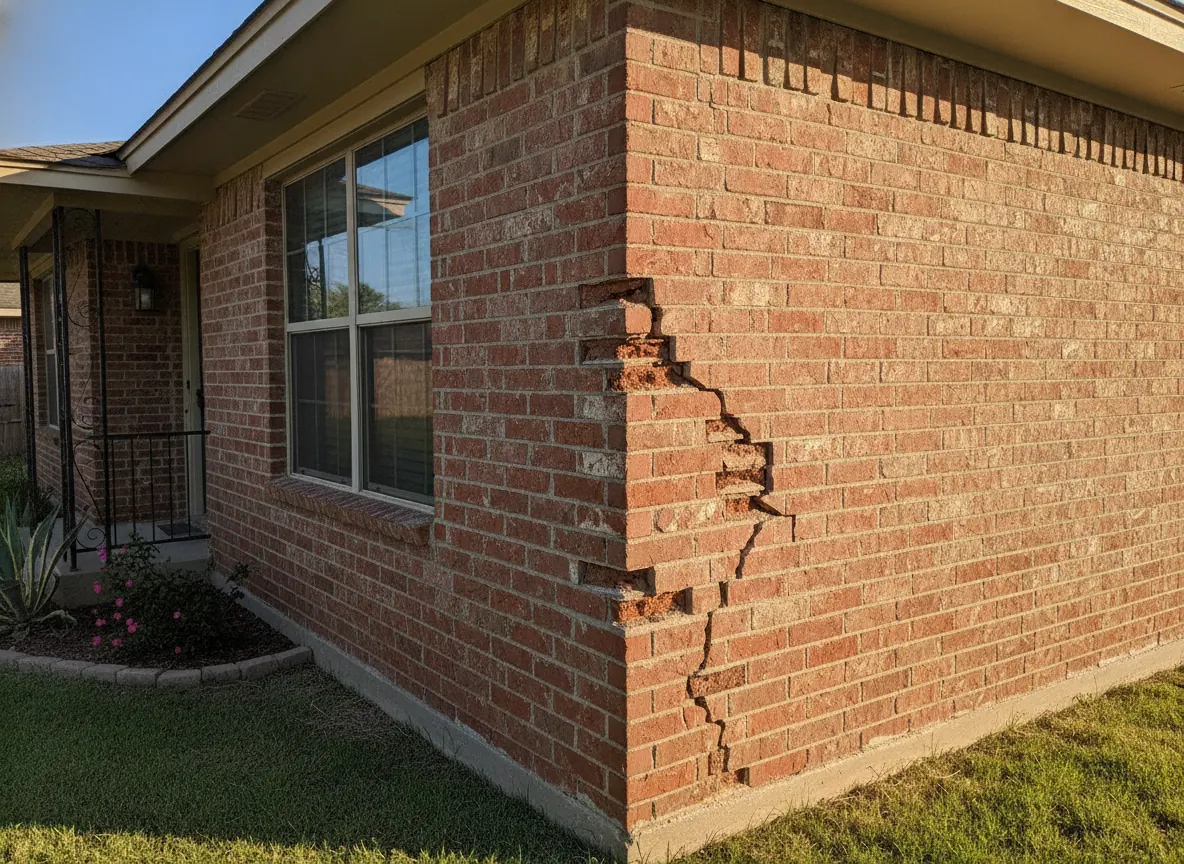
Stair-step cracks in brick
A crack that zigzags up through the mortar joints of a brick wall, often from the corner of a window or door, is the classic sign people associate with foundation movement. It can mean one part of the foundation has dropped or lifted relative to another. A short stair-step crack can also come from the brick itself expanding and contracting. Width, offset and whether it is growing tell you more than the shape alone.
Horizontal and wide cracks
A long horizontal crack in a block or concrete wall, especially if the wall bows inward, suggests pressure from the soil outside. That is less common in East Texas, where most homes are slab-on-grade or pier and beam rather than basements, but it can show up in retaining walls, crawl space walls and older block foundations. Cracks wider than about a quarter inch, or with one side offset from the other, deserve a professional look whatever their direction.
Slab cracks and cracked tile
A crack in the slab often shows up first as a line of cracked floor tile or a ridge under carpet. On its own it may be shrinkage. Combined with sloping floors, a door that suddenly binds or a crack that lines up with one in the brick outside, it points toward movement. See slab foundation repair for what companies typically check.
Warning signsThe signs that matter more than the crack
Texas home inspectors are told to look for a specific set of signs when they give an opinion on how a foundation is performing. They make a good checklist for homeowners too.
- Doors that bind, sit out of square or will not latch
- Gaps where trim, frieze boards or framing have pulled apart
- Floors that slope or feel uneven
- Cracks or separations in walls, windows, floors or ceilings
- Brick or stone cladding that is rotating, buckling, cracking or bulging
In a Texas home sale, a TREC-licensed inspector must give a written opinion on how the foundation is performing and list signs like doors that stick, sloping floors, and cracks in walls or brick (22 TAC §535.228). An inspector's opinion isn't an engineering evaluation.
In Tyler, many of these signs show up or get worse in late summer. That fits the climate: July is the driest month on average and the city sees about 98 days of 90°F-plus heat (NOAA 1991–2020 normals). As the soil dries, it can pull away from a slab edge. Some cracks partly close again after fall rains.
How to monitor a crack
Mark the ends
Draw a short pencil line across each end of the crack and write the date beside it.
Measure the width
Use a ruler, a crack gauge or a set of feeler gauges at the widest point and write it down.
Photograph it
Take the same photo from the same spot each month, with a ruler or coin in the frame.
Check the doors
Note which doors stick and when. A door that binds in August and swings free in March is a useful clue.
A crack that grows past its marks, widens or starts to offset over a few months is telling you something. One that stays put through a full summer usually is not.
Is it urgent? Most cracks are not emergencies. Have someone look soon if a crack is widening quickly, a wall is bowing, doors or windows suddenly jam, you can see daylight through a gap, or you suspect a plumbing leak under the slab (a jump in the water bill, warm spots on the floor, or damp flooring). If there is any risk of something falling or a gas smell, leave the house and call the gas company or 911 first. Then see foundation crack repair.
Who to call: a foundation company or an engineer
A foundation repair company can evaluate the house and give you a quote, usually free. An engineer gives you an opinion that is not tied to selling a repair. An independent Texas-licensed professional engineer works for you, not the repair company. You can look up a PE's license with the Texas Board of Professional Engineers and Land Surveyors (pels.texas.gov). Published guides put an engineer foundation inspection at about $300–$1,000 (This Old House, October 2026). An engineer can make sense when cracks are wide, quotes disagree, or you are buying or selling. See foundation inspections.
Texas does not issue a state license for foundation repair companies, so check experience, insurance, written warranties and reviews yourself, and ask whether a licensed professional engineer (PE) designs or signs off on the repair.
What crack repair typically costs
Typical national ranges from published 2026 cost guides (Fixr, Jan 2026; This Old House, Oct 2026). Your price depends on an on-site evaluation.
| Item | Typical range | Source |
|---|---|---|
| Crack sealing / epoxy injection | $200–$1,000 | Fixr, Jan 2026 |
| Slab foundation repair | $1,000–$10,000 | Fixr, Jan 2026 |
| Piers (underpinning), per pier | $1,000–$3,000 each | Fixr, Jan 2026 |
| Structural engineer report | $300–$2,000 | Fixr, Jan 2026 |
Sealing or epoxy-injecting a crack fixes the crack, not the cause. If the foundation is still moving, a sealed crack can reopen nearby. Ask whether the company recommends sealing alone, sealing plus drainage, or piers, and why. The Tyler foundation repair cost guide has more ranges and a planning calculator.
When you are ready, describe the crack once and independent East Texas companies can reply with quotes. Photos and your monitoring notes help. Call (323) 880-1300 to be connected with a local foundation repair company.
Frequently asked questions
Are hairline cracks in a slab normal?
Often, yes. Concrete shrinks as it cures, and many slabs develop thin cracks. A hairline crack that stays the same width, does not offset and comes with no other signs is usually cosmetic. Mark it and check it over a summer.
Is a stair-step crack in brick serious?
It can be a sign that part of the foundation has moved, but it is not proof. Width, offset, whether it is growing, and other signs such as sticking doors or sloping floors matter more than the shape. A widening stair-step crack is worth having evaluated.
When is a foundation crack an emergency?
Few are. Have someone look soon if a crack widens quickly, a wall bows, doors suddenly jam, you see daylight through a gap, or you suspect a slab leak. If anything might fall or you smell gas, leave and call the gas company or 911 first.
How much does it cost to fix a foundation crack?
Published national guides put crack sealing or epoxy injection at about $200–$1,000 (Fixr, January 2026). If the foundation is still moving, a larger repair such as piers may be needed, and those costs are much higher. Ask each company to explain the cause before you pay to seal the crack.